 |
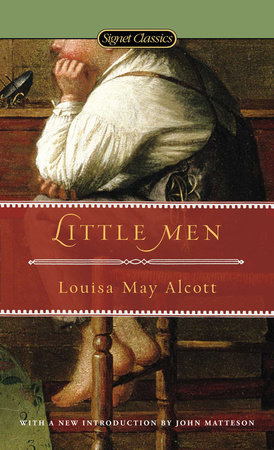
| (Not my picture, but this version is the copy I own.) |
Note: I'm actually unsure whether the things mentioned here count as spoilers, since Little Men is something of a slice-of-life. If you haven't read the book, I personally think reading this post won't spoil your future reading of Little Men.
Set after the events of Little Women, Little Men invites us into the hustle and bustle of a school called Plumfield. (Honestly Plumfield isn’t really a school in the traditional sense. But we’ll use the word “school” for convenience’s sake. Read the book to find out what it’s like!) We follow Jo March and husband Frederick “Fritz” Bhaer as they run this school of theirs.
This time Louisa May Alcott introduces a roster of mainly male characters, predominantly the boys - aka “little men” - studying at Plumfield. Nevertheless adult characters do still make appearances. There’s this one thing about them, perhaps really trivial, that caught my eye. Sometimes Alcott describes them as a “boy” or “girl” - as if they’re children - instead of the usual “man/gentleman” or “woman/lady”. It’s kind of cute, isn’t it? In addition to adding cuteness, I think this strengthens a main theme in Little Men: There are certain areas in which adults are encouraged to imitate children, and should not be ashamed to do so.
Child’s Play
A certain moment from Chapter 11 of the book was what kickstarted this whole thought process:
“By the way, I’ve got a book somewhere here that you may like to see,” said the oldest boy of the party, diving under the seat and producing a book which made Dan exclaim: …
In Chapter 11, Mr. Laurie pays a visit to Plumfield. He invites three boys - Demi, Nat, and Dan - to have some fun riding a carriage. Inside, he presents Dan with a book. Alcott, however, chooses not to mention the giver by name and simply describes him as “the oldest boy of the party”. Initially this had me confused. I wasn’t sure who this “oldest boy” was. Wasn’t Dan the oldest among them? But there’s no way he gave a book to himself. Did one of the older boys - Franz, for example - join them? But then I realized that Alcott was referring to Laurie. Mr. Laurie, now an adult man, is suddenly referred to as a boy.
After leaving the carriage, Mr. Laurie shares a playful chat with Jo and the boys, and here he actually calls himself a boy:
“Oh, dear, no! I’m the first boy Mrs. Jo ever had to take care of, and I was such a bad one that she isn’t done with me yet, though she has been working at me for years and years.”
Another example which I really like is something Jo says in Chapter 9:
“Bless your buttons, dear, I know all about it; and here is a boy who will toss up for me,” added Mrs. Jo, as the professor peeped over the rock with a face full of fun.
Several boys had invited Jo up a hill, to which Jo agreed. It’s then revealed that the boys had prepared kites for everyone to fly. Demi tells Jo he’ll help toss up her kite in a moment, but Jo gives the reply above. She tells Demi not to worry since another boy will help her with it. Jo calls Mr. Bhaer a boy! Isn’t that such a cute thing to say?
Jo does the same in the book’s opening chapter:
“I am Mother Bhaer, that gentleman is Father Bhaer, and these are the two little Bhaers.-Come here, boys, and see Nat.”
In Chapter 1, Jo welcomes Nat to Plumfield. She escorts Nat into a room where Mr. Bhaer and his two sons were play-wrestling. Wanting them to come over, Jo beckons to them and calls them “boys”. This one is particularly interesting because Jo had just called her husband “gentleman” and “Father”. Next moment she lumps him together with his two little sons.
In the instances above, Mr. Laurie and Mr. Bhaer are called boys when they’re having fun: Laurie goes carriage-riding with the boys, Fritz tosses up a kite and wrestles. They’re not ashamed to partake in children’s play. So I think we can say that an area in which adults are encouraged to imitate children is in having fun. Have some fun - don’t be ashamed of playing like children again!
Masculinity
The examples above all happen to show men. This is bound to happen since most of the cast are men and boys. The only adult woman who appears consistently in the story is practically Jo. But I think Alcott’s also trying to say something about masculinity. There are very clear instances where Alcott does this. She does not, for example, see physical brawls, drinking, and smoking as displays of true masculinity. Thus by calling men “boys” at times, I think Alcott is saying that true masculinity isn’t about becoming super rigid, tough, and the like. To Alcott, one sign of true masculinity is allowing yourself to be child-like in moments of fun.
To conclude…
To end this post, I present to you a description of Jo from chapter one. It really left an impression on me when I read it. From early on Alcott highlights that retaining certain childlike qualities is a good thing; that growing up isn’t about tossing away each and every childlike quality. May we learn to muster up the bravery to be child-like again!
She was not at all handsome, but she had a merry sort of face that never seemed to have forgotten certain childish ways and looks, any more than her voice and manner had; and these things, hard to describe but very plain to see and feel, made her a genial, comfortable kind of person, easy to get on with, and generally “jolly”, as boys would say.

No comments:
Post a Comment